I find connections among books, art, music, libraries, travel, crafts and food.
Showing posts with label book repair. Show all posts

Wednesday, August 6, 2014

A Book a Week 2014: Made, Altered, Repaired. Week 24

Week of 16 June

College Library Rebacking

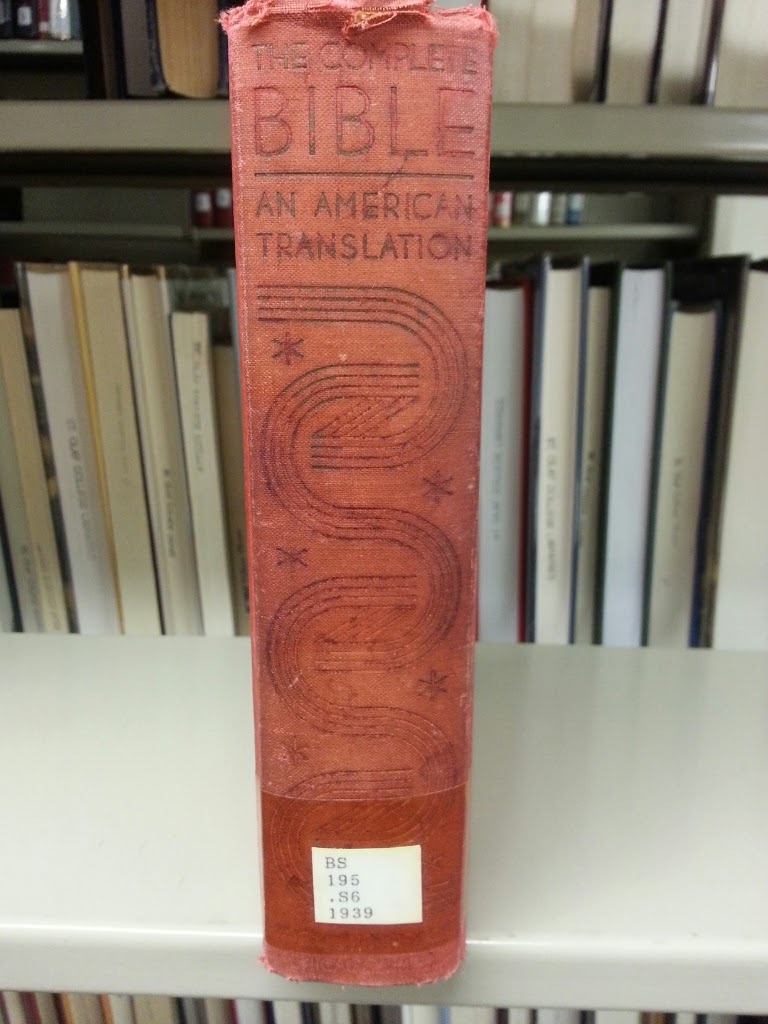
While doing some archival work on the World Languages Bibles at St. Olaf College, I walked through the regular stacks of Bibles and Religion books. I worked for 2 years in the conservation lab at UW-Madison, learning how to repair books. A lot of what I did every day was rebacking. Rebacking refers to repairing a spine or making a new spine. We always tried to preserve as much of the original as possible, without creating more damage.

It appears most colleges did the same thing, repairing books to allow them to be checked out more. Here are some examples of rebacking (well, there are some that are totally recased).




Monday, August 4, 2014

A Book a Week 2014: Made, Altered, Repaired. Week 22

Week of 2 June

Book Repair Class - Rebacking

I taught another basic book repair class at the library. There was a full house (10), but we had enough space and repairs to work on.

Rebacking is a bookbinding term that means replacing and/or repairing the spine of a book.
Here is an excellent training guide from Minitex.


Look how proud John is! He did a really nice job rebacking this old textbook. You can tell this tool man is used to working with his hands.


Saturday, February 22, 2014

A Book A Week 2014: Made, Altered, or Repaired. Week 5.

Week of Feb. 3, 2014

Another repair. Ghost Towns of Colorado.

TS asked me if I could repair this book, with a note, "Please save, if possible."
As you can see, these endsheets have cool photos, but were quite damaged, partly from acidic paper, but also from library tape, stickers, due date slips and envelope glue. I decided to give it a try.

I learned, from working in the conservation lab at UW-Madison Memorial Library, to remove glued-on paper you should try methyl cellulose. Basically, it's wallpaper paste, but also an inert, low tack, removable glue. Methyl cellulose is a versatile tool in book repair, conservation and bookbinding. You can add it to your PVA glue to lengthen the drying time when you're doing detail work. It can be used straight as a glue to attach book plates which can be removed easily by wetting the plate with water.

For book repair, we use it to loosen old glues and remove glued paper. So I applied the methyl cellulose to the endsheets on the boards. It took some time (hours) before the paper started to come loose. I used my micro spatula to gently lift off the paper.
 
The boards were too acidic and crumbling to keep, but I wanted to retain the look of an older book. I had a discarded Guideposts volume, which was about the size I needed. The only problem was the title on the cover. I carefully cut out the Guideposts title with an exacto knife, and printed a new title to insert in its place.


I used a bit of my metallic coloring to make it look not-quite-new.


I even found the original spine piece underneath some book repair tape, so I reattached it to the new spine.


Monday, January 27, 2014

A Book A Week 2014: Made, Altered, or Repaired. Week 3

Week of 20 Jan 2014

Another repair at the public library. This one was particularly attractive to me for 3 reasons:
1. It was about Cicero. I was a Latin major (the language, not the geographic area) in college. My professor (James M May, Classics professor at St. Olaf College), is an expert on Cicero and talked about him all the time.
2. The endsheets are awesome - map of Italy and part of the Mediterranean.
3. I really like the color!

So, here you can see, the spine was coming off, and the book was looking shabby.

 Here's the endsheets:
 First, I removed the boards, and tidied them up. I relined all edges by applying book repair tape (the darker green), lifting the original lighter green book cloth to tuck the tape under.

Next, I created a new spine out of book tape:
 I've never used binder tape before, but I found it in the repair closet. I wanted to learn how to use it and to see how effective it was. For this purpose, I think it worked great. It is not what I'd use for an archival repair, but it will keep the book strong and able to survive many circulations.


Attaching the spine to the covers:

Some of the endsheet had to be covered because of damage:

 And I was able to attach the original spine label to the newly made spine.

 In good shape, and labeled for checkout:

A Book A Week 2014: Made, Altered, or Repaired. Week 2

Week of 13 Jan 2014
This is a book I repaired for Rochester (MN) Public Library. Book repair has different functions at different kinds of libraries. Generally, at a public library, you repair books that are out of print, but still circulating. If a book is still in print, the public library will usually just discard a nasty (dirty, ripped, stained, unreadable) and order a new copy. Also, the type of repair you would do on a public library book is different than the type of repair you would do in an archives (if you repair it at all, or you might just create a box to place it in). 
In a public library, you want to get as many circs out of the book as you can, so you want it to be durable.

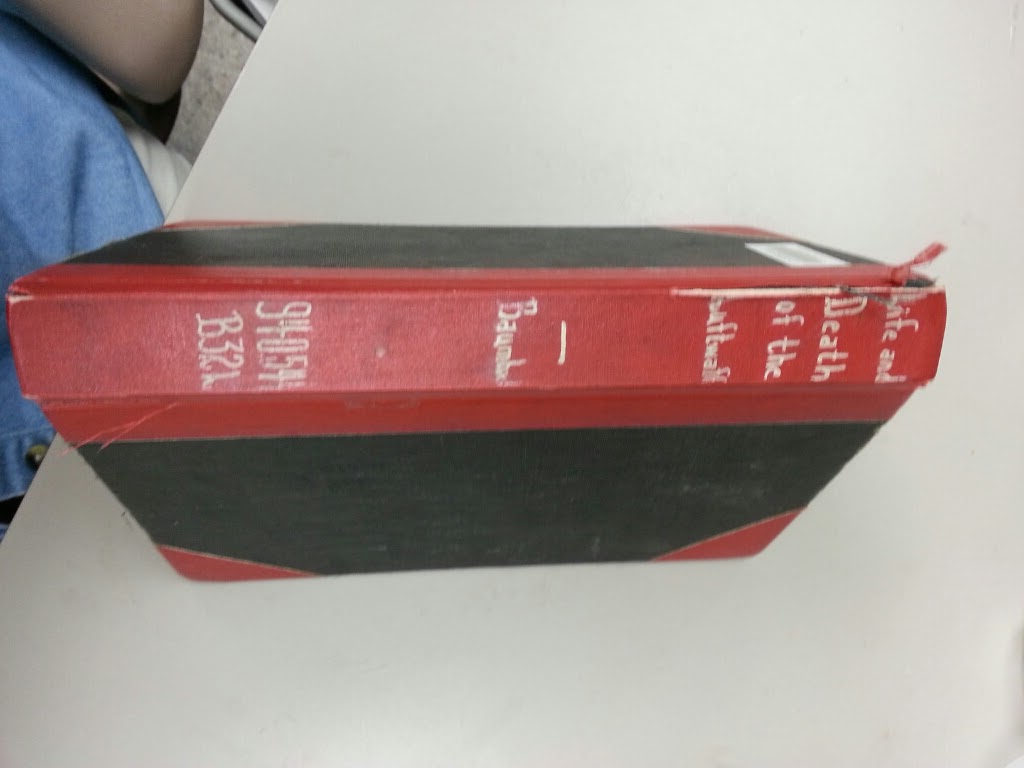
You can see the before and after on the spine of this book. Above, you see a red spine with a handwritten label. Once I took the book apart, I found the original spine under the red one. I liked the look of the red accents on the black book, so I created a new spine with red repair tape, but glued on the original spine label. I think it looks smart, don't you?                                             

 I gave it new corners for a half-bound book.
The book is now ready for many more circulations.